Language Resources for Visitors

Simple English–Thai resources to help SHALOM visitors greet, listen and communicate respectfully during home visits.

SHALOM Home Visit English–Thai

Practice useful phrases for arriving at a family home, asking how everyone is doing, listening well, offering prayer and saying goodbye.

Open the Home Visit Role-Play →

SHALOM Home Visit Role-Play

Visiting a Person with a Disability and Their Family

How to use this guide: Read the English first, then the Thai. “Say it” gives a simple English-letter pronunciation. Male speaker: ครับ (krap). Female speaker: ค่ะ/คะ (ka).
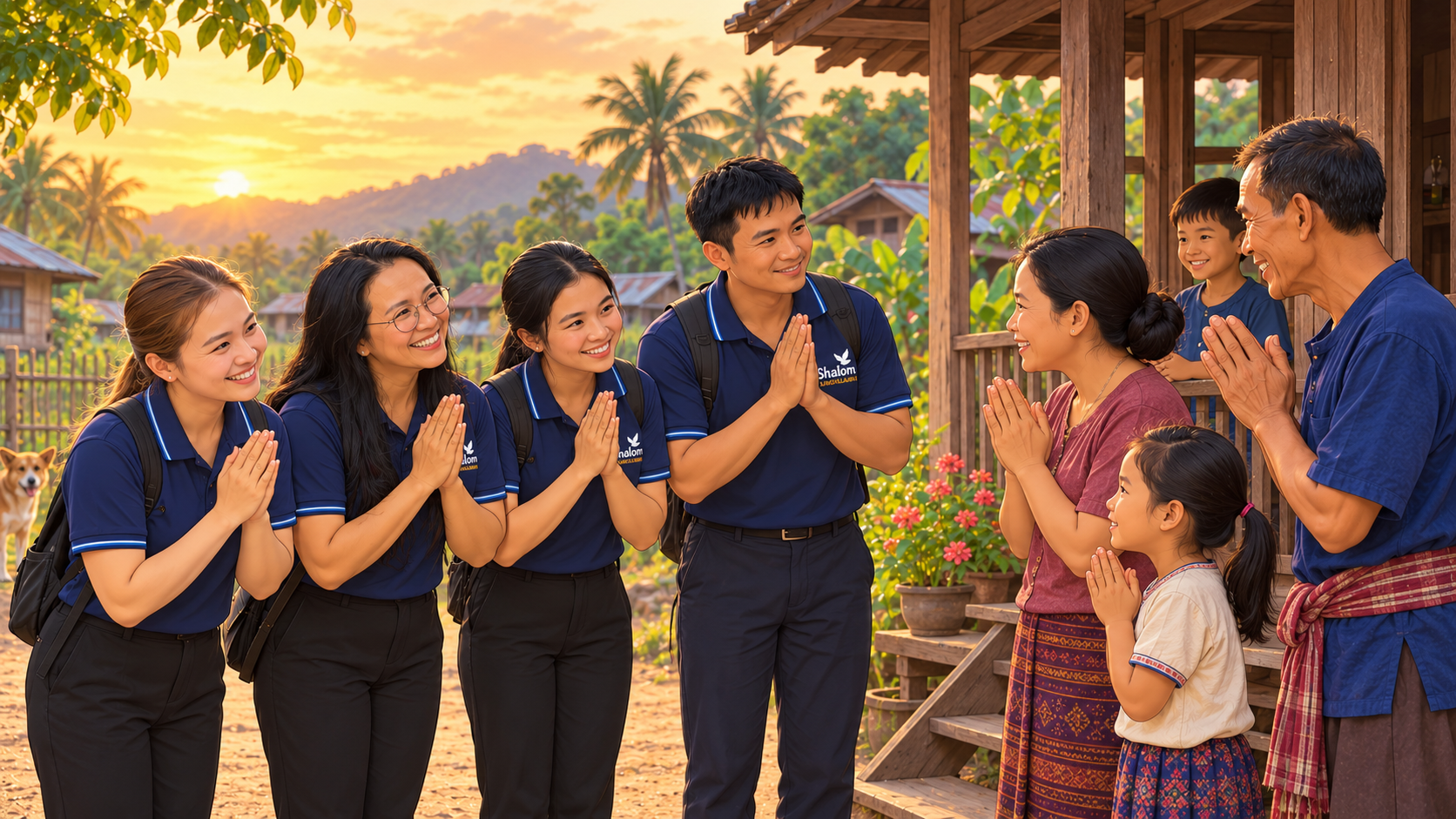
SHALOM team greeting a village family with a respectful wai

Arrive as guests: warm, respectful and ready to listen.

1. Arriving at the Home

Hello!
สวัสดีครับ/ค่ะ
Say it: sa-wat-dee krap/ka
We are visiting from SHALOM Foundation.
พวกเรามาเยี่ยมจากมูลนิธิ SHALOM ครับ/ค่ะ
Say it: puak rao ma yiam jak moon-la-ni-ti Sha-lom krap/ka
We’re very happy to see you today.
พวกเราดีใจมากที่ได้มาเจอทุกคนวันนี้ครับ/ค่ะ
Say it: puak rao dee-jai mak tee dai ma jer took kon wan-nee krap/ka

2. Greeting the Person and Family

How are you doing today?
วันนี้เป็นอย่างไรบ้างครับ/คะ
Say it: wan-nee pen yang-rai bang krap/ka?
I’m doing well, thank you.
สบายดีครับ/ค่ะ ขอบคุณครับ/ค่ะ
Say it: sa-bai-dee krap/ka, kop-khun krap/ka

3. Have You Eaten Yet?

Have you eaten yet?
กินข้าวแล้วหรือยังครับ/คะ
Say it: gin khao laeo reu yang krap/ka?
Yes, we have. Thank you.
กินแล้วครับ/ค่ะ ขอบคุณครับ/ค่ะ
Say it: gin laeo krap/ka, kop-khun krap/ka
In Thailand, “Have you eaten?” is often a caring everyday greeting.

4. Asking About the Family

How are things with your family lately?
ช่วงนี้คนในครอบครัวเป็นอย่างไรกันบ้างครับ/คะ
Say it: chuang-nee kon nai krop-krua pen yang-rai gan bang krap/ka?
Everyone is doing well, thanks.
ทุกคนสบายดีครับ/ค่ะ ขอบคุณครับ/ค่ะ
Say it: took kon sa-bai-dee krap/ka, kop-khun krap/ka

5. Showing Interest and Listening

How have things been for you lately?
ช่วงนี้เป็นอย่างไรบ้างครับ/คะ
Say it: chuang-nee pen yang-rai bang krap/ka?
Is everything going okay at home?
ที่บ้านช่วงนี้ทุกอย่างเรียบร้อยดีไหมครับ/คะ
Say it: tee ban chuang-nee took-yang riap-roi dee mai krap/ka?
Is there anything you would like to tell us?
มีอะไรที่อยากเล่าให้พวกเราฟังไหมครับ/คะ
Say it: mee a-rai tee yak lao hai puak-rao fang mai krap/ka?
Can I help you?
ให้ช่วยไหมครับ/คะ
Say it: hai chuay mai krap/ka?

6. Encouraging the Family

We’re very happy we could visit you.
พวกเราดีใจมากที่ได้มาเยี่ยมครับ/ค่ะ
Say it: puak-rao dee-jai mak tee dai ma yiam krap/ka
Thank you for spending time with us.
ขอบคุณที่ใช้เวลากับพวกเรานะครับ/คะ
Say it: kop-khun tee chai way-la gap puak-rao na krap/ka

7. Offering Prayer

May we pray for you and your family?
พวกเราขออธิษฐานเผื่อคุณและครอบครัวได้ไหมครับ/คะ
Say it: puak-rao kor a-ti-than puea khun lae krop-krua dai mai krap/ka?
Is there anything you would like us to pray for?
มีเรื่องอะไรที่อยากให้พวกเราอธิษฐานเผื่อเป็นพิเศษไหมครับ/คะ
Say it: mee rueang a-rai tee yak hai puak-rao a-ti-than puea pen pi-set mai krap/ka?

8. Preparing to Leave

Thank you so much for coming today.
ขอบคุณมากนะครับ/คะที่มาเยี่ยมวันนี้
Say it: kop-khun mak na krap/ka tee ma yiam wan-nee
Thank you for having me. I had a wonderful time.
ขอบคุณมากครับ/ค่ะที่ต้อนรับผม/ฉัน วันนี้ผม/ฉันมีความสุขมากครับ/ค่ะ
Say it: kop-khun mak krap/ka tee ton-rap pom/chan, wan-nee pom/chan mee kwam-sook mak krap/ka

9. Saying Goodbye

Get home safe. Visit us again soon!
เดินทางกลับโดยสวัสดิภาพนะครับ/คะ มาเยี่ยมกันอีกเร็ว ๆ นี้นะครับ/คะ
Say it: dern-tang glap doi sa-wat-di-pap na krap/ka, ma yiam gan eek reo-reo nee na krap/ka
See you again soon!
แล้วพบกันใหม่นะครับ/คะ
Say it: laeo pop gan mai na krap/ka
God bless you!
ขอพระเจ้าอวยพรครับ/ค่ะ
Say it: kor pra-jao uay-pon krap/ka

10. Christmas Greeting

Blessed Christmas!
ขอพระพรในวันคริสต์มาสครับ/ค่ะ
Say it: kor pra-pon nai wan Christmas krap/ka

11. Easter Greeting

Blessed Easter!
ขอพระพรในวันอีสเตอร์ครับ/ค่ะ
Say it: kor pra-pon nai wan Easter krap/ka

Short Practice Dialogue

Visitor: Hello! We are visiting from SHALOM Foundation.
สวัสดีครับ/ค่ะ พวกเรามาเยี่ยมจากมูลนิธิ SHALOM ครับ/ค่ะ

Visitor: How are you doing today? Have you eaten yet?
วันนี้เป็นอย่างไรบ้างครับ/คะ กินข้าวแล้วหรือยังครับ/คะ

Visitor: How are things with your family lately?
ช่วงนี้คนในครอบครัวเป็นอย่างไรกันบ้างครับ/คะ

Family: Everyone is doing well, thanks.
ทุกคนสบายดีครับ/ค่ะ ขอบคุณครับ/ค่ะ

Visitor: May we pray for you and your family?
พวกเราขออธิษฐานเผื่อคุณและครอบครัวได้ไหมครับ/คะ

Visitor: God bless you. See you again soon!
ขอพระเจ้าอวยพรครับ/ค่ะ แล้วพบกันใหม่นะครับ/คะ

Simple Cultural Reminders

top of page

Shalom

Sangkhlaburi Homecare Assistance Liaisons Of Mercy

​Bringing the SHALOM of God’s love to the ill and needy of Sangkhlaburi District through community health nursing, visitations, homecare and education assistance.

  • Medic-nurse outreach with telemedicine

  • Coordination of medical care with Anamai (district health outpost)

  • Home nursing care

  • Caregiver support

  • Companionship

  • Pastoral-counselling and Evangelism

  • Palliative care

  • Community Health

  • Livelihood training

  • Charity fund for insurance, transport, medical care

  • Afterschool education

  • Community projects and video-based outreach

Community Healthcare

The outreach team includes a medic-nurse healthcare worker along with a pastoral-counsellor to assess the needs, provide home nursing care, caregiver support, and address the emotional, companionship and spiritual needs of the clients.

​

Since the program started in January 2020, we have served 85 clients and assisted 24 clients with the terminal phase of their illnesses. We schedule homecare assistance with the visitation schedule and level of care determined by their health condition, nursing needs, and family support.

​

The assistance offered by the SHALOM program includes telemedicine, bedside procedures for wound/bedsore care, tracheostomy, stoma and enteric fistula care, indwelling catheter and feeding tube care, medication reconciliation, health monitoring, caregiver training and relief, companionship, music therapy, pastoral counselling, physical-occupational therapy, nutritional support, home visits for diagnostic blood test taking, accompanying to medical appointments, medical charity assistance, transport assistance and subsidy, assistance with registration for border health medical insurance.

​

We work closely with doctors in local clinics, the hospitals and the government village health outpost staff (Anamai) to provide the intensive home nursing care that our clients require. In addition to a focus on Homecare Aide livelihood support training, we have also assisted with the design and installation of solar power off-grid systems, water purification, shallow well water systems and animal rearing livelihood assistance (odorless pig and duck farming).

IMG_0391_edited.png

Our objective ​is to provide suitable low-income, rural people with skills-training as Homecare Aides for livelihood support.

​

Program Details

  • Monthly stipend  

  • Training in practical homecare and community health skills

  • Eldercare and disabled care livelihood positions

  • Development of life skills and education qualifications with mentoring by SHALOM trainers

​

Currently, we have three trainees under the CALiSTA project. 

​

Care Aid Livelihood Support Training Assistance​

the CALiSTA project

IMG_0223
IMG_0349
IMG_0382
IMG_4144
IMG_8254
IMG_0390
bottom of page