Language Resources for Visitors

Simple English–Thai resources to help SHALOM visitors greet, listen and communicate respectfully during home visits.

SHALOM Home Visit English–Thai

Practice useful phrases for arriving at a family home, asking how everyone is doing, listening well, offering prayer and saying goodbye.

Open the Home Visit Role-Play →

SHALOM Home Visit Role-Play

Visiting a Person with a Disability and Their Family

How to use this guide: Read the English first, then the Thai. “Say it” gives a simple English-letter pronunciation. Male speaker: ครับ (krap). Female speaker: ค่ะ/คะ (ka).
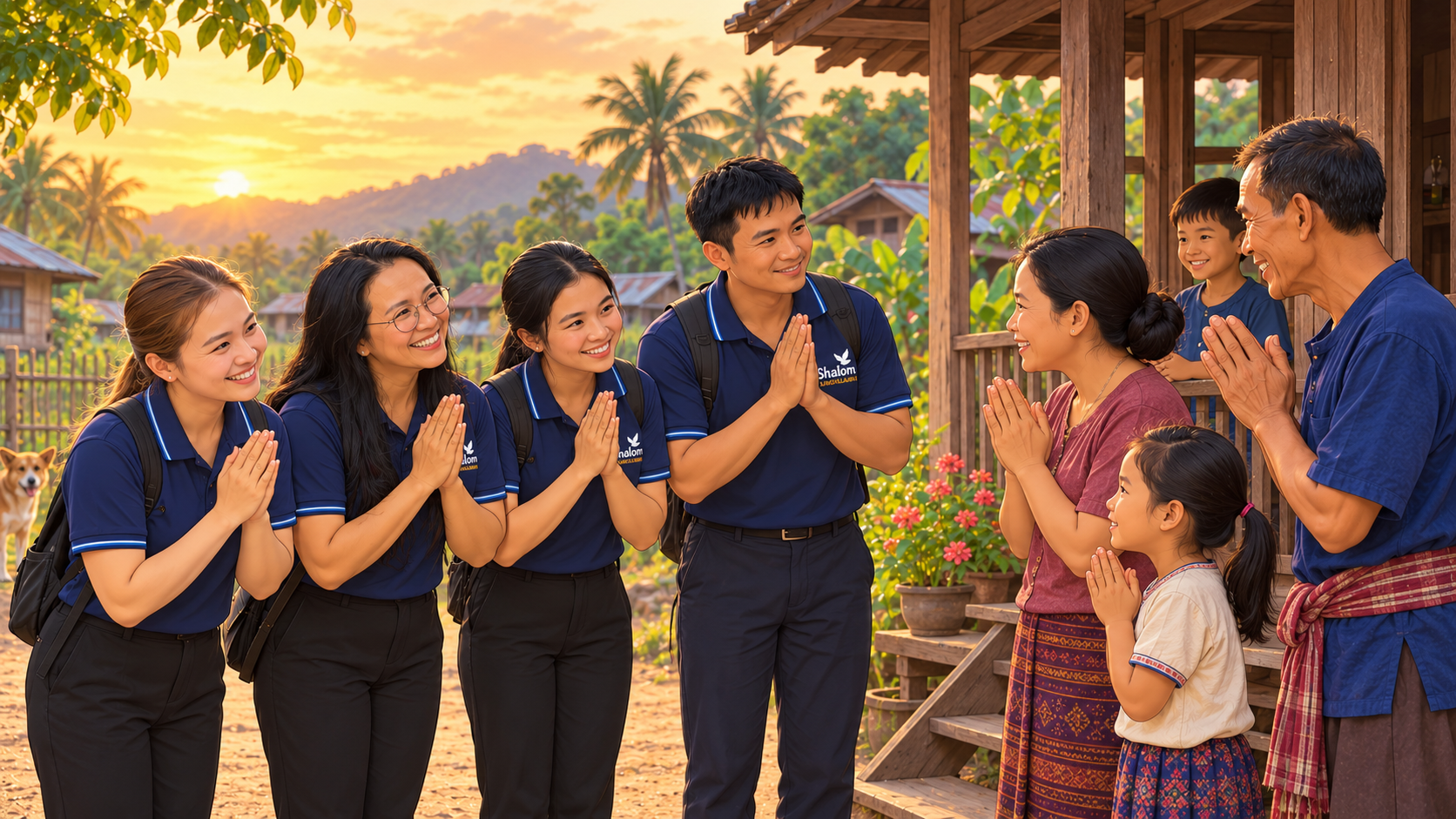
SHALOM team greeting a village family with a respectful wai

Arrive as guests: warm, respectful and ready to listen.

1. Arriving at the Home

Hello!
สวัสดีครับ/ค่ะ
Say it: sa-wat-dee krap/ka
We are visiting from SHALOM Foundation.
พวกเรามาเยี่ยมจากมูลนิธิ SHALOM ครับ/ค่ะ
Say it: puak rao ma yiam jak moon-la-ni-ti Sha-lom krap/ka
We’re very happy to see you today.
พวกเราดีใจมากที่ได้มาเจอทุกคนวันนี้ครับ/ค่ะ
Say it: puak rao dee-jai mak tee dai ma jer took kon wan-nee krap/ka

2. Greeting the Person and Family

How are you doing today?
วันนี้เป็นอย่างไรบ้างครับ/คะ
Say it: wan-nee pen yang-rai bang krap/ka?
I’m doing well, thank you.
สบายดีครับ/ค่ะ ขอบคุณครับ/ค่ะ
Say it: sa-bai-dee krap/ka, kop-khun krap/ka

3. Have You Eaten Yet?

Have you eaten yet?
กินข้าวแล้วหรือยังครับ/คะ
Say it: gin khao laeo reu yang krap/ka?
Yes, we have. Thank you.
กินแล้วครับ/ค่ะ ขอบคุณครับ/ค่ะ
Say it: gin laeo krap/ka, kop-khun krap/ka
In Thailand, “Have you eaten?” is often a caring everyday greeting.

4. Asking About the Family

How are things with your family lately?
ช่วงนี้คนในครอบครัวเป็นอย่างไรกันบ้างครับ/คะ
Say it: chuang-nee kon nai krop-krua pen yang-rai gan bang krap/ka?
Everyone is doing well, thanks.
ทุกคนสบายดีครับ/ค่ะ ขอบคุณครับ/ค่ะ
Say it: took kon sa-bai-dee krap/ka, kop-khun krap/ka

5. Showing Interest and Listening

How have things been for you lately?
ช่วงนี้เป็นอย่างไรบ้างครับ/คะ
Say it: chuang-nee pen yang-rai bang krap/ka?
Is everything going okay at home?
ที่บ้านช่วงนี้ทุกอย่างเรียบร้อยดีไหมครับ/คะ
Say it: tee ban chuang-nee took-yang riap-roi dee mai krap/ka?
Is there anything you would like to tell us?
มีอะไรที่อยากเล่าให้พวกเราฟังไหมครับ/คะ
Say it: mee a-rai tee yak lao hai puak-rao fang mai krap/ka?
Can I help you?
ให้ช่วยไหมครับ/คะ
Say it: hai chuay mai krap/ka?

6. Encouraging the Family

We’re very happy we could visit you.
พวกเราดีใจมากที่ได้มาเยี่ยมครับ/ค่ะ
Say it: puak-rao dee-jai mak tee dai ma yiam krap/ka
Thank you for spending time with us.
ขอบคุณที่ใช้เวลากับพวกเรานะครับ/คะ
Say it: kop-khun tee chai way-la gap puak-rao na krap/ka

7. Offering Prayer

May we pray for you and your family?
พวกเราขออธิษฐานเผื่อคุณและครอบครัวได้ไหมครับ/คะ
Say it: puak-rao kor a-ti-than puea khun lae krop-krua dai mai krap/ka?
Is there anything you would like us to pray for?
มีเรื่องอะไรที่อยากให้พวกเราอธิษฐานเผื่อเป็นพิเศษไหมครับ/คะ
Say it: mee rueang a-rai tee yak hai puak-rao a-ti-than puea pen pi-set mai krap/ka?

8. Preparing to Leave

Thank you so much for coming today.
ขอบคุณมากนะครับ/คะที่มาเยี่ยมวันนี้
Say it: kop-khun mak na krap/ka tee ma yiam wan-nee
Thank you for having me. I had a wonderful time.
ขอบคุณมากครับ/ค่ะที่ต้อนรับผม/ฉัน วันนี้ผม/ฉันมีความสุขมากครับ/ค่ะ
Say it: kop-khun mak krap/ka tee ton-rap pom/chan, wan-nee pom/chan mee kwam-sook mak krap/ka

9. Saying Goodbye

Get home safe. Visit us again soon!
เดินทางกลับโดยสวัสดิภาพนะครับ/คะ มาเยี่ยมกันอีกเร็ว ๆ นี้นะครับ/คะ
Say it: dern-tang glap doi sa-wat-di-pap na krap/ka, ma yiam gan eek reo-reo nee na krap/ka
See you again soon!
แล้วพบกันใหม่นะครับ/คะ
Say it: laeo pop gan mai na krap/ka
God bless you!
ขอพระเจ้าอวยพรครับ/ค่ะ
Say it: kor pra-jao uay-pon krap/ka

10. Christmas Greeting

Blessed Christmas!
ขอพระพรในวันคริสต์มาสครับ/ค่ะ
Say it: kor pra-pon nai wan Christmas krap/ka

11. Easter Greeting

Blessed Easter!
ขอพระพรในวันอีสเตอร์ครับ/ค่ะ
Say it: kor pra-pon nai wan Easter krap/ka

Short Practice Dialogue

Visitor: Hello! We are visiting from SHALOM Foundation.
สวัสดีครับ/ค่ะ พวกเรามาเยี่ยมจากมูลนิธิ SHALOM ครับ/ค่ะ

Visitor: How are you doing today? Have you eaten yet?
วันนี้เป็นอย่างไรบ้างครับ/คะ กินข้าวแล้วหรือยังครับ/คะ

Visitor: How are things with your family lately?
ช่วงนี้คนในครอบครัวเป็นอย่างไรกันบ้างครับ/คะ

Family: Everyone is doing well, thanks.
ทุกคนสบายดีครับ/ค่ะ ขอบคุณครับ/ค่ะ

Visitor: May we pray for you and your family?
พวกเราขออธิษฐานเผื่อคุณและครอบครัวได้ไหมครับ/คะ

Visitor: God bless you. See you again soon!
ขอพระเจ้าอวยพรครับ/ค่ะ แล้วพบกันใหม่นะครับ/คะ

Simple Cultural Reminders

top of page

Making Do

By Dr. Phil McDaniel

From the 1960s through the 1980s the hospital was still quite remote. Budget was tight. Much of the equipment had been donated and was quite old. To keep expenses low we made do with the materials and equipment we had.

​

With no regular electricity available during the day, we had to either start a “back-up” generator to provide power for, say, surgery or x-rays, or we had to schedule procedures for a time in the night when we expected that there would be electricity.

our generator

This 15 kVA 2-cylinder diesel generator was run from dusk to about 10 PM each night in the mid 1980s to supply the mission compound with power the first part of each night. Outside of these regular hours, it was used for urgent electric power needs at the hospital such as x-rays or surgery. After the arrival of government power in the late 1980s, it became a backup generator used during the frequent power outages.

b0010632-e1536210932555_edited_edited.jp

Nurse Eiam providing the air pressure required for a nebulizer treatment for an asthma patient, using a bicycle pump.

b0010690_edited.png

Another asthma patient getting a nebulizer treatment powered by air pressure from a bicycle pump.

b0010614-e1536285611308_edited_edited.jpg

This man had been gored in the chest by a wild ox and had a collapsed lung on the right with some bloody fluid in his chest. I put in a chest tube to drain the fluid and help re-expand the lung. The only suction machine we had at the time was this hand-operated vacuum cylinder. It was not very efficient. Staff were encouraged to stop and give a few pulls on the vacuum pump each time they passed by the room. The patient made a gradual recovery. In fact, he is the happy fellow returning home by boat with his family in my “Boats, Carts and Elephants” post.

b0010692_edited.png

This spotlight, powered by a motorcycle battery, was primarily used by the night watchmen for the hospital and mission compound. It was also useful by day to search for termite entry points. When the electricity went off in the middle of an operation, it came in very handy as an emergency light source.

b0010635-e1536291076237.jpg.webp

hand saws

In the 60’s and 70’s there was no electric cast saw. Casts had to be removed by small crescent-shaped hand saws. This was a tedious task assigned, in this case, to the hospital gardener. Sometimes it was assigned to a friend or relative of the patient or even the patient himself!

bottom of page